The Ember Report.
You find out a fire needs you when the phone rings. By then, the date is set, and your team scrambles.
A CIMT got named. A fire changed hands. A Type 3 IC stepped up to a Type 3 Team. It's not always clear where to find that information, and it seems like a full-time job.
You are not slow. You are working blind, guessing against people who aren’t.
What would your operation look like if you had known a day earlier to expect those calls?
The Ember Report reads the moves for you. Which teams are mobilizing, escalating, taking command, or standing down, and what that means for likely resource orders.
The Ember PRO portal holds the whole picture, updated hourly: every move as we learn it, every fire's command history, any hour you need it.
What you get
Two real lines from recent briefings:
CIMTEgypt (OR-MAF · Harney Co.) SA 2 (Complex team) mobilized Jul 17, per the national team roster, while federal incident data still listed a Type 3 IC.
REPORTED
Anthony (OR) Northwest Team 13 · reported here Jul 16, confirmed +1 day later.
CONFIRMED BY THE OFFICIAL RECORD
Short, scannable, sourced. Every morning by 8:30 AM Mountain.
The portal: up-to-the-minute team movements
A briefing tells you what moved overnight.
The portal is where Pro readers stay ahead of the news. Every team move, newest first, with a marker where you left off. Every fire has a page: who holds command, how it got there, the facts at a glance. Search any fire or team, this season or last.
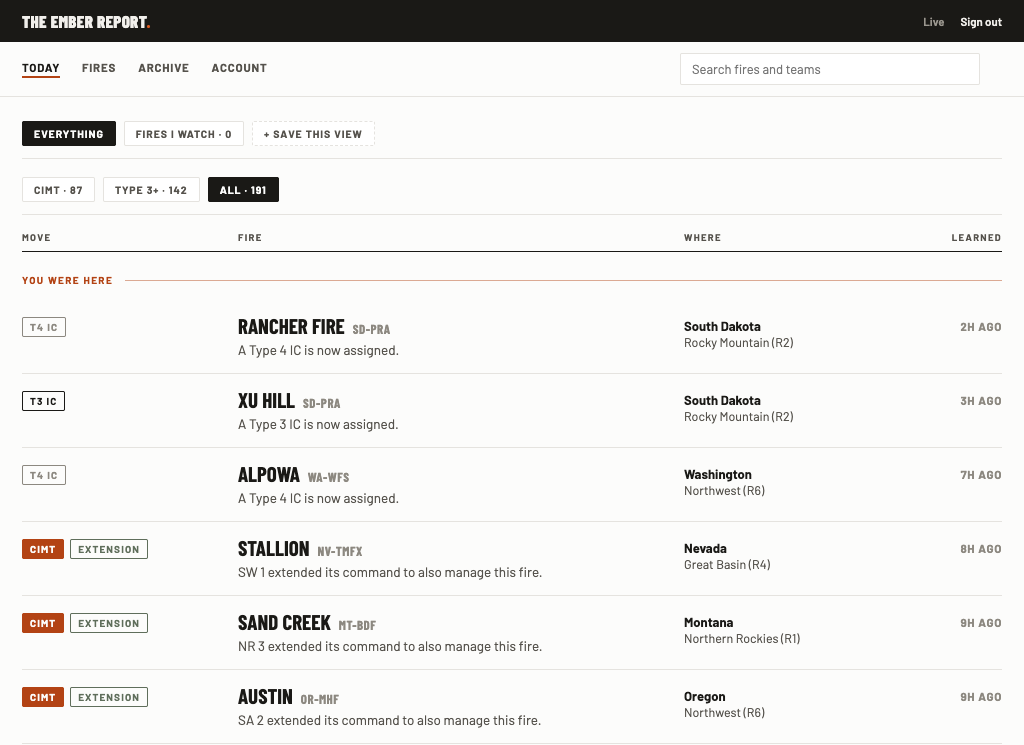
It's in every Pro subscription.
Two briefings, one promise
Pro — the team updates the morning we see them, plus the portal to stay ahead. The Ember Report names which teams are mobilizing, escalating, or standing down, days before the official record. The portal holds every move, every fire's command history, and the archive; sign in any time. Your first 7 days are Pro, automatically. No credit card required.
Free — the proof, every morning. Early calls confirmed by the official record with the dates side by side, the day's NIFC report read for you, and fire weather.
Government access: $0
Sign up with your government email address to get the same briefing Pro readers pay for. All federal, state, local, and tribal agencies qualify. It has no end date, and we never ask you for a card.
This rate is published and open to every government employee. It is not offered to you personally, and nothing is asked of you in return.
Government employee? Start here →Weather that signals what comes next
When conditions turn dangerous, the briefing leads with them:
Lightning Fire RiskHIGH
Critical fire weather is present today in the Northern Rockies and Southern Area, both projected to develop lightning and ignition risk. The pattern is still building, with conditions intensifying into early next week.
Escalating conditions, 7-day trend
West MontanaJul 18 (Sat) – Jul 24 (Fri)
Northern SierrasJul 18 (Sat) – Jul 24 (Fri)
Rio Grande Plains SouthJul 18 (Sat) – Jul 23 (Thu)
Generic forecasts tell you it's hot. We flag the weather that starts fires: lightning over receptive fuels and critical fire weather, ranked by risk, with the zones where it's building next. When risk runs high, it moves to the top of your briefing. Quiet days stay quiet.
Tomorrow's orders are already taking shape.
This is a real Pro briefing, days ahead of what free readers see.
We love Watch Duty, but there's a lot of noise: initial attacks dominate the map. What contractors need is timely detail on what actually drives equipment ordering.
How it works
1.We watch federal incident data and the national team roster all day, every day.
2.Pro readers get the briefing the day a team moves, and the portal tracks everything since the last briefing. Free readers get every call the morning the official record confirms it, receipt attached.
3.When the official record catches up, we show the receipt. On the record, every time.
The context is the edge
Here's what a Cal Fire call-out looks like in the briefing:
CAL FIRECal Fire incident, Type 3 IC, 900 personnel on 2,100 acres. Expect heavy equipment first: tenders and dozers.
REPORTED
Nine hundred people on a fire sounds like camp, catering, and hauling. Not yet. On a Cal Fire Type 3 IC fire, expect heavy equipment first: tenders and dozers. Camp support stays light until a State Type 1 or 2 IMT takes command. That's the read we attach to every signal, so you staff right instead of chasing the head count only.
That know-how is the point. The Ember Report exists to professionalize fire contracting: better information, better reads, a more capable industry.
Built by a contractor who spent 10+ years supplying wildfire operations, reading equipment demand before the orders were official.
New here? How to read the briefing